
I just finished my latest and longest production yet. It has a lot of community members participating in it, new and old, and I’m very proud of how it turned out. I’d be lying if I said the process was anywhere close to smooth but since everyone seems to be aware this collab took over 2 years to finish, I think it deserved a proper look into why it took so long and the complications that arose (all of which are my fault and mine alone).
My goal is to document my journey and give insight to those wishing to do the same or to just learn about the process of a larger indie production. I have learned a lot from the last 28 months of work and I hope this little blog post of mine helps you in pursuing your next project!
Table of Contents
Adapting A Child’s Game
I’m always thinking of good ideas for collabs to host, though not all of them fit the format I do best with. I’ve hosted plenty of synced fight collabs and a joint or two, and I had started to develop a new compilation style with Stuntman and YouTube Rewind 2020 [Animator’s Edition]. This style is built to allow as many animators to participate as possible while allowing them to have full creative control over their entries. It’s an artist-first compilation style modeled after Pluto’s methods in the Doors series. I believe the best animations come from a simple prompt, so the collab’s concept has to follow the rule of simplicity to work.
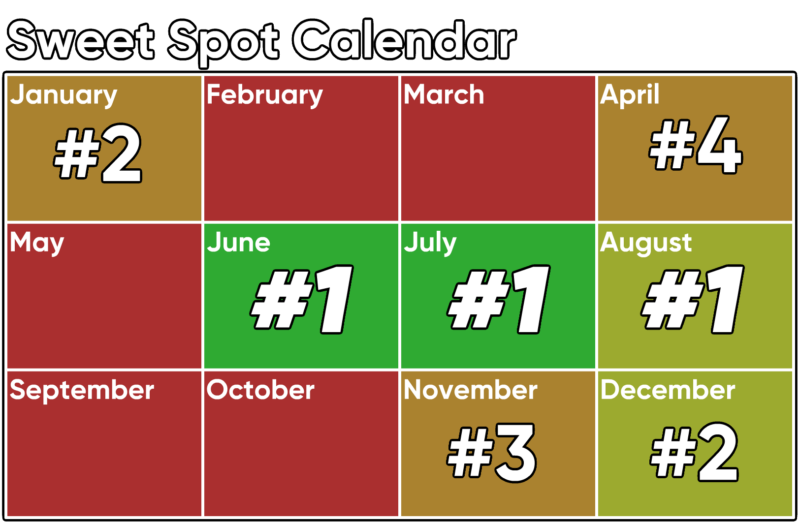
If you want to host a collab, there are good and bad times of the year to host them. If it’s a smaller-scaled project that doesn’t involve too many people, then it doesn’t matter too much when you host it so long as you can properly communicate with your participants / friends but if it’s a large scaled collab where you allow the entire community to participate, then there’s a few periods during the year that are best. Most animators wanting to participate in these collabs are likely in high school and college. When a break from school comes, they’ll often participate in smaller projects for fun or to build their portfolio depending on their profession they’re building towards. If you want to target this demographic then you should aim for the usual school break times, but they all come with caveats.
Fall and Spring break usually keep people busy with their families and they also don’t last long. Some people may be available but not many in comparison to Winter break. Winter break is the second best time to host a collab, but participants will likely still be busy with their families for the holiday season. Winter breaks tend to be longer than Spring and Fall breaks so they generally do still have some off time. It’s important to keep in mind that a lot of students will also have homework piled up during these breaks which may tank their availability to work on your collab even further, but it’s generally not smart to only keep students in mind. Most adult artists are busy year-round so these breaks don’t mean much to them as they have entered the work-force and work 9-5s, leaving them tired every day with only the weekend to recover. Even when they do have a break, they get lives and start families. That’s why you don’t see a lot of the “OGs” in the community anymore. That doesn’t mean you shouldn’t count them out entirely though!
The best time to host a collab is during summer break. It’s the longest stretch of time most students have free for themselves and is generally the time a lot of artists will take vacations and slow down on work for a bit, opening the gates for both major demographics. Summer break starts at different times for everyone but generally everyone is more available around June and July. This is what I call the “Summer Sweet Spot”.
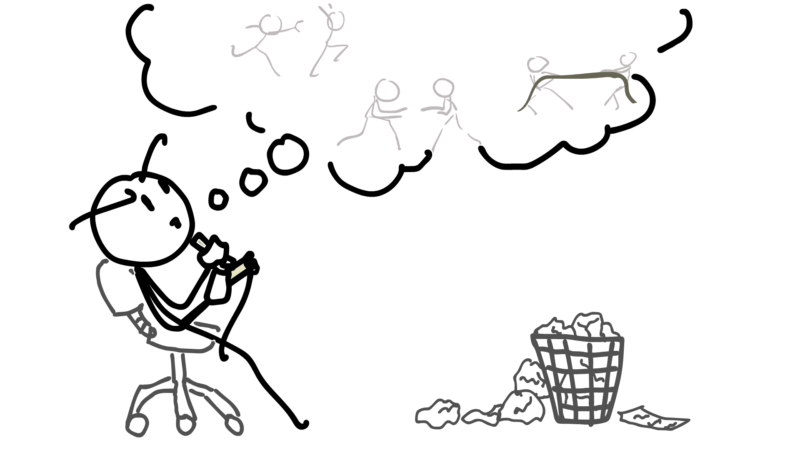
The conceptualization of this collab started in the spring of 2024. I had published my last major collab the previous summer season, meaning I had to come up with an idea for summer of 2024 to host my next major collab. I didn’t want it to be Stuntman again since a friend of mine, Egor, expressed to me that he’d like to see me do something new and I agreed. I needed something simple that everyone could understand, like a child’s game. My first idea was tag, but the concept was too vague for an entry-based collab meaning each entry wouldn’t be able to naturally transition into each other. Eventually I came up with the idea of Rock Paper Scissors, a universally understood child’s game. I considered implementing “Ultimate Rock Paper Scissors” but that can easily make things too complicated. I thought the concept was a fun and easy-to-grasp concept so I started producing a concept of the template in Adobe Animate in May of 2024, 1 month before the sweet spot.
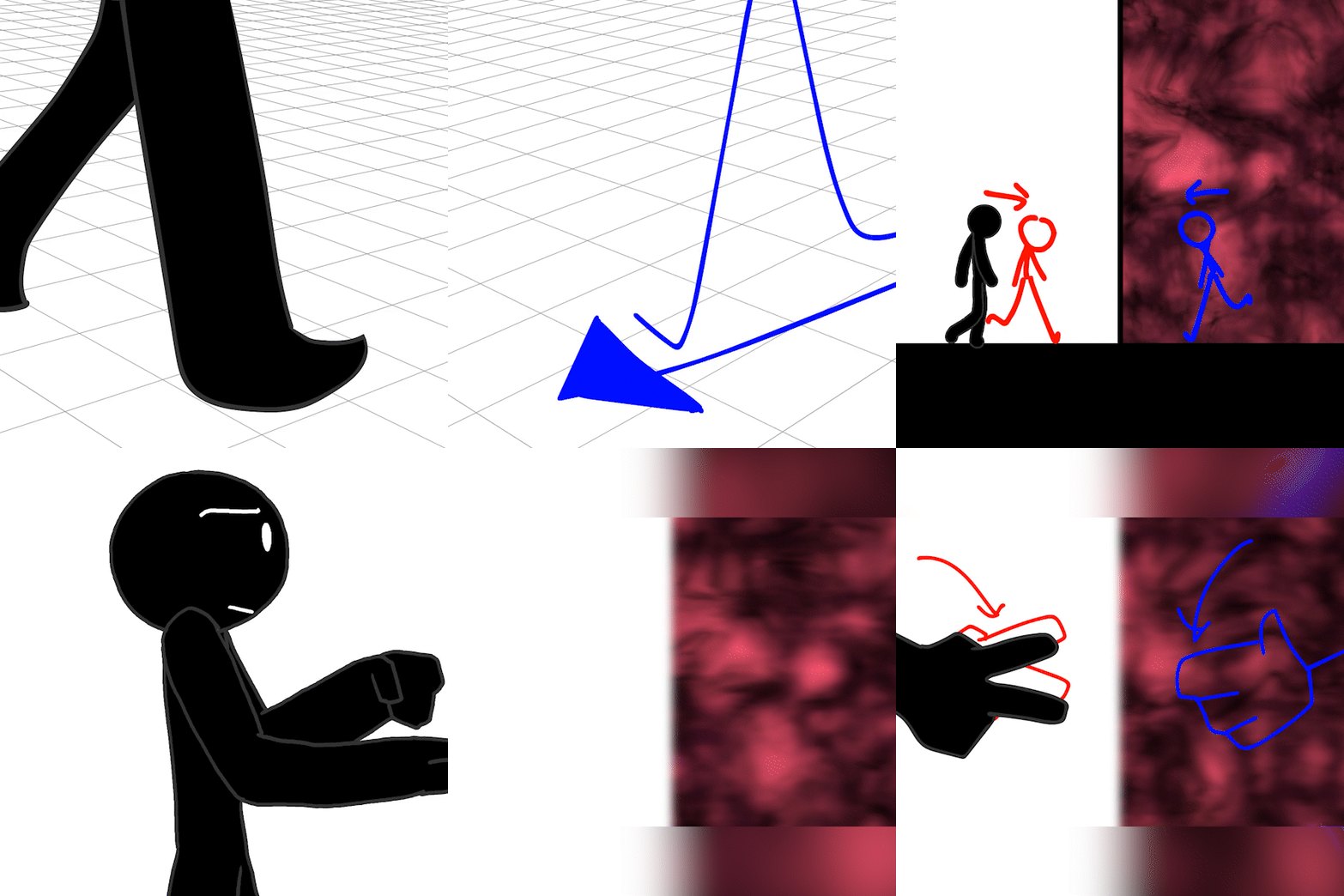
I wanted to allow every animator to make their own background to avoid forcing them into a premade background, so I originally decided to contextualize the prompt by having each animator appear in a portal that would show them in another dimension or reality, allowing them to face their opponent while having a completely different environment. I eventually realized this complicated a simple concept. There didn’t need to be a reason for them to face off with different environments, so I left it unexplained. I animated an example of how to animate an entry and utilized scenes in Animate to make it easy to understand for Animate & Flash users, then handed it to TJB & Lunsar to see how they do with the template. They understood it well and handed their entries back to me so I could complete a proof of concept. This ended up becoming the
announcement trailer since it clearly shows the potential participants what they can expect the collab to look like. I showed the concept off in a private section of my Discord server and I got some really encouraging words from other animators, expressing how it looked fun! Great! That filled my confidence quite a bit so I asked Avenza, a musician who has worked on projects in the community before, if they could produce original music for the trailer and they accepted.
Over-Explaining
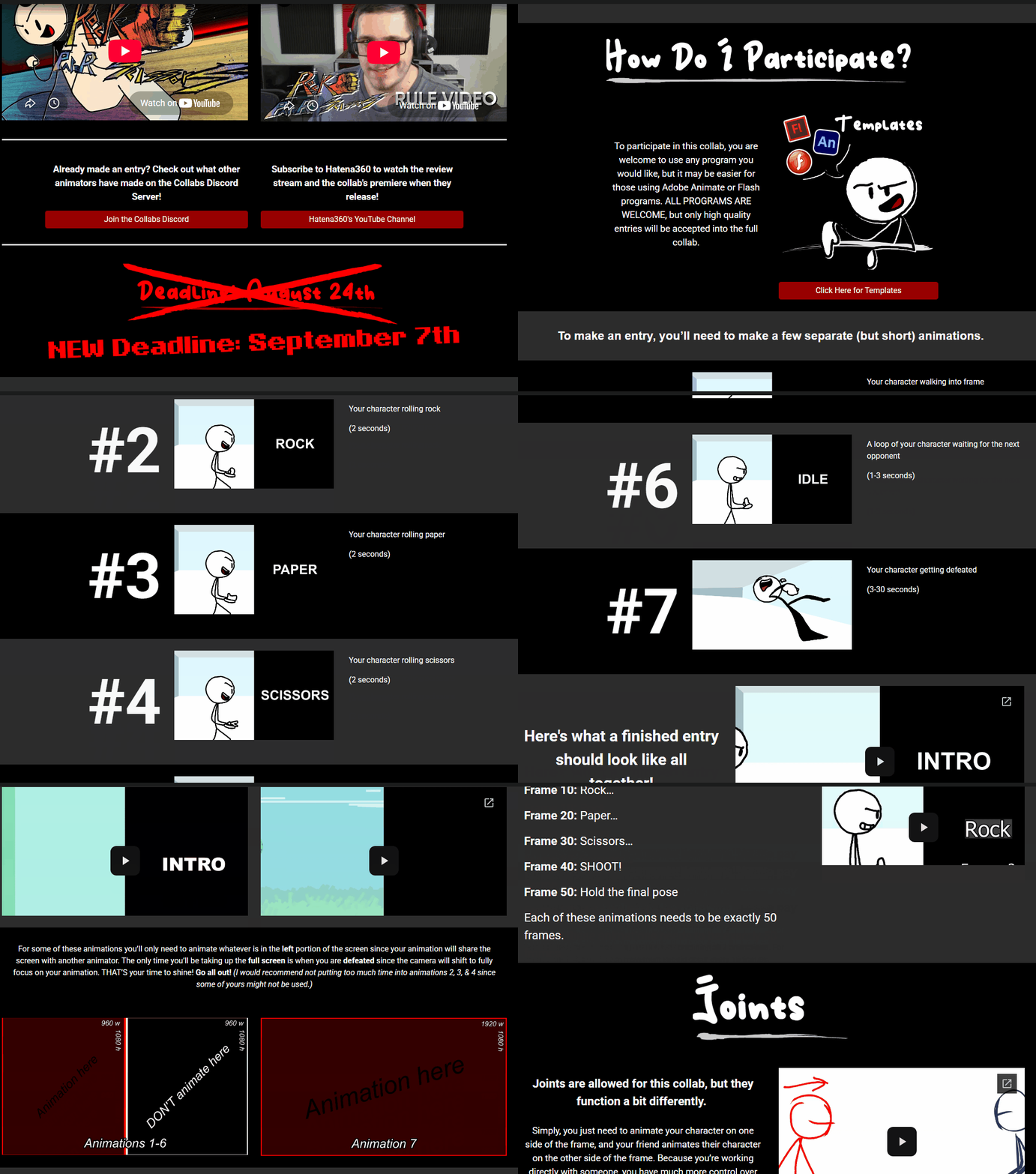
Now I had a good Flash and Animate template and a good proof of concept, but I needed a way to allow people who don’t use Flash or Animate to participate. In order to allow as many people to participate as possible, I needed to be able to clearly and efficiently instruct users how to make an entry for the collab without a proper template so I decided to host a Google Site to compile a clear and easy-to-read webpage that explains exactly that. It explains the frame data, duration, and purpose for each animation. I essentially needed everyone to animate each animation as if they were sprites for a game that can be pulled when selecting a certain input, this way I can pull any animation I needed to fit next to another participant’s entry. I even included a video guide explaining everything since most people don’t like to read so they’ll skim through the instructions and miss key-details that can result in their entry getting denied.
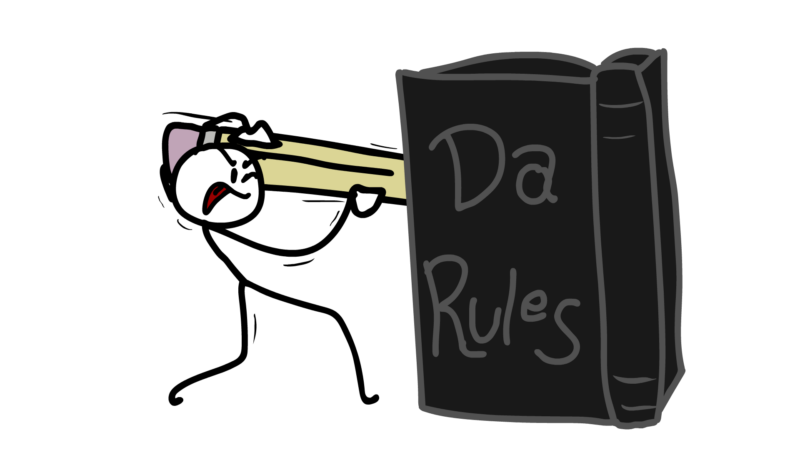
With the instructions and templates ready and prepared, I released the trailer on June 8th, 2024. Knowing that each animation was going to need a bit of extra time to complete, I announced the collab with a fake deadline. You may be surprised to hear that fake deadlines are fairly common in large-scaled community collabs, and I may even make some of those hosts mad by talking about it here publicly but I want to be fully transparent with this project. It’s like a trade secret in collabs to give everyone a fake deadline usually of 2 weeks, then announce an “extension” of another 1-2 weeks. The reason we do this is based on worker’s psychology.
Let’s say you’re working on an essay the day before it’s due. You might start rushing it and prepare to lose some points on it, or you might just be ready to give up. You then suddenly hear that the essay’s deadline is delayed by another week or two, which will likely cause you to return to the essay you wrote and put a bit more work in to make it better or even perfect. This is the same strategy we use to encourage people to finish their entries if they either rushed it or gave up on it. It’s all to increase the total number of entries submitted. We don’t use this strategy all the time since people would eventually pick up on it, but chances are if you see a deadline extension then it was planned from the start.
August 24th was the initial deadline for RPS, which was already pretty risky. It’s known among hosts that participants lose motivation fast, usually after no longer than 2 weeks so starting with an 11 week deadline is ill-advised, but I know people needed more time than usual for this concept. I eventually extended the deadline another 2 weeks making the total participant duration for most participants 13 weeks, much longer than most successful large-scaled public collabs.
Even though I tried my best to make everything as easy to understand as possible, this is where everything falls apart. While the collab’s prompt was easy to understand, the way I wanted to compile this went against that major rule of simplicity. The complexity of the format and specifications of the instructions made it less of a fun thing to animate in your free time, and more of a chore to try and have your work shown to a larger audience. My assumption is that most animators started working from the first animation, the entrance, and worked their way to the defeat animation. While I expressed the main point of the collab is to animate a
unique defeat animation, there was still a lot of work to do just to get to the defeat that they likely got burnt out or ran out of time. Some might have had fun, but there was another major consequence of forced complexity I had introduced that I wouldn’t be able to see until I reviewed each entry live.
Everybody Explodes
The concept and ethics of a review stream have been on my mind a lot lately. I’ve been thinking about their history and how I’ve done them in the past, and how to do them better going forward. They’re honestly one of my least favorite parts of hosting a public collab, but if you want to hear me yap about that more then there’s a video on my second channel where I talk all about it.
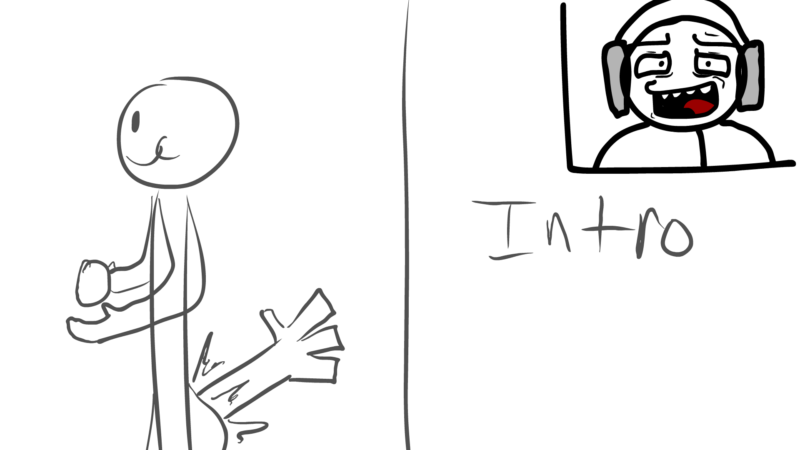
On September 8th of 2024 I streamed a live review going over every valid submitted entry for RPS. The stream took nearly 6 hours to get through everything but I had noticed a sad pattern when reviewing entries. The point of this collab was to focus on the defeat portions of each person’s entry, but a lot of them were disappointing due to the concept not being simple as mentioned earlier. Even in the final product you can see a lot of animators defaulting to the same punchline. “Everybody explodes” became a common sentiment during private and public screenings of the collab. While during compilation I could try to spread these entries out so they didn’t seem like such a frequent pattern, they were so common that it had little to no impact. I think it’s funny if you focus on the concept as a “bit” but it does make some of the entries feel unoriginal to each other. There were still a lot of fun and original entries though!
Clip from the stream of my reaction to Rojackie’s entry
Collabs should be simple. They thrive on simplicity. Think of the best collabs out there and this rule will always apply. The Greatest Swordsman by Op34 is a collab where you get to fight people with swords. Obstacle Course Collabs are successful because all you have to do is go through an obstacle course. The Doors series by Pluto did it best since all you had to do was enter and leave a room. You could do anything you wanted so long as you did those two things. That’s the beauty of these collabs, they’re simple to understand as an animator and as a viewer. You can be more complex with a collab and have it be successful but then you lose the power of simplicity to make it truly appealing to a larger audience. If you don’t care about a larger audience then do whatever you want! Who cares? But even I haven’t sat down to watch the Color Stealer Collab series because I don’t fully get the idea from the packaging alone.
RPS was a simple concept, but it was only simple on 1 side; the viewer’s side. The concept was not simple for the animators which ruined its simplicity. This collab was produced with the idea first and the execution second. My desire to make it as open and accessible as possible made it more complex than it ever needed to be. If I were to redo this collab, I would not make it an entry-based public collab but instead, I’d make it a joint. A joint would have made much more sense in hindsight since it would allow the animators to be able to riff off of each other directly making each interaction feel much more intentional. The only joint entry in this collab ended up being one by Darkstar & Silly Scribe who kept tying until one of them got fed up. This entry was phenomenal because they made the interaction between the two characters feel natural and fully intentional. This is only one of the reasons why in my eyes, this collab failed. They had full creative control. Nobody else did. Not even I did.
Editing Backwards
The day after the stream, I started organizing the entries. With 40% of the total submitted entries being accepted and 15% being put to the side in case they do work, a majority of the entries, 43% were denied outright. This was because the animator either didn’t follow one or more of the rules or their entry just wasn’t up to the quality I was looking for. To give you a full understanding, 89 out of 203 entries were not accepted into the collab after the review stream. I still wanted to give people a chance so I allowed people to continue submitting entries after the review stream but I wouldn’t review them publicly and I would fully close submissions once the rough edit was complete. I organized all of the necessary information in a Google spreadsheet that contained their username, drive video link, extra credits, and a quick note to help me know from a glance what each part was. Once I put their names into the collab itself, I’d mark their row as green to make crediting everyone easy and efficient, though this did still result in some people’s names getting misspelled in the final render. This is mostly my fault, though there are some users who simply misspelt their own names so just double check next time you submit your entries to a collab.
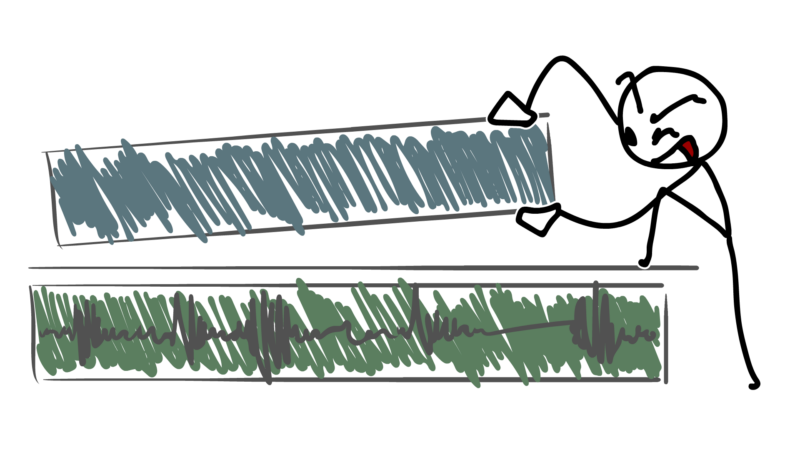
Once everything was organized, I started moving files into Adobe Premiere to begin the rough edit. The rough edit is where I take the tracks I’d like to be in the collab and line up each entry until I run out of space, leaving polishing stages for later just so I can get the structure completed and out of the way. Due to my compilation style, this proved to be difficult this time around. I like to sync up key moments of people’s entries with the music to make it more dynamic and engaging, which means sometimes I have to tweak entries to sync up to the music a bit better. I try to leave people’s entries untouched but if I can reasonably hold on a frame for a bit or slow a movement down by changing the video’s speed to make that entry more engaging while keeping their entry mostly intact, I think it results in a much better impression on the viewer that’ll make that moment stick in their head and play it back. With collabs like Stuntman, it was easy to place an entry at a certain point of the song where it syncs well and fill in the gaps later, but this time I lost that level of control. Every entry had very specific timing to work and since the part I needed to sync was at the end of their entry, I ended up compiling the entries rom the end of the song and working my way back. I was still able to use frame holds and speed changes to sync things up a bit better but these were very difficult to do. Sometimes you may notice entries holding for a long time. This was an artifact from trying to fill in the gaps to sync up other moments in the track.
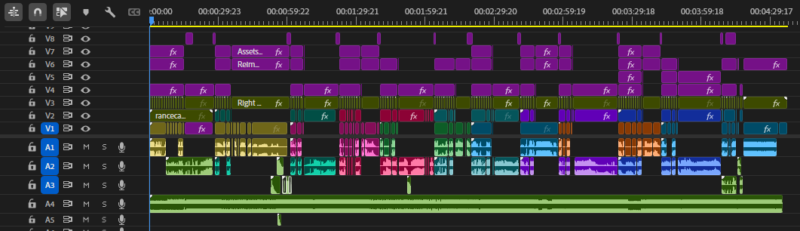
Premiere timeline of one of the fully compiled and edited segments
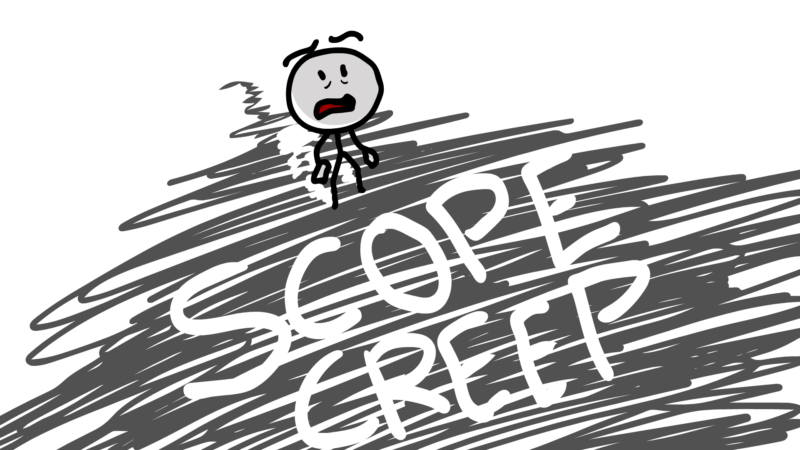
This alone made this collab the most challenging to compile and made me regret hosting the collab. It caused me to pause production numerous times and was one of the first times I considered cancelling the project due to low confidence. The only reason I continued is because I thought once the rough edit was done, that would be the most difficult part of the production and it would be downhill from there. That was true, until I allowed scope creep to strangle this project.
Musical Complications
Scope creep is when you keep adding on ideas and challenges to a project until it becomes overwhelming to a point you consider starting over or cancelling the project. The scope can change in any given project during production of course, that’s natural. It’s not natural to let that continue for months and even years until it’s no longer what it once was. Finding and implementing a musical identity is where we begin to see scope creep enter the production of the RPS collab.
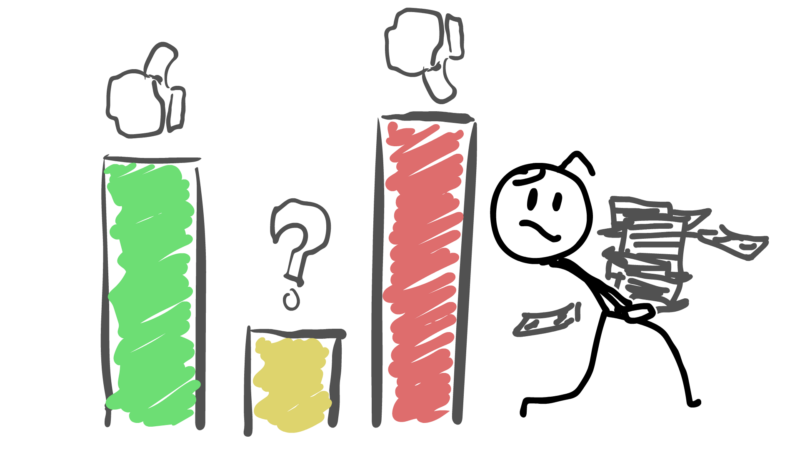
My collabs are heavily revolved around music and the energy they share with the entries they play with. If there’s a bunch of sinister or edgy parts, I tend to shift towards a more dark and bass-y track like Cjbeards’ music. If I want something with a lot more consistent energy to match a lot of high-movement and action entries, I can usually trust Koven to have a good track to fit. This does introduce a severe challenge when trying to monetize a collab like this. I usually am forced to find royalty free music to avoid copyright calais and potential strikes, or subscribing to a music label monthly to gain their licenses for the majority of their tracks like Monstercat. This is why you’ll see ms use a lot of songs from NCS or Bass Rebels as well since there’s no licensing fee attached. More recently I’ve been experimenting with YouTube’s beta music library but most of those tracks sound very… free.
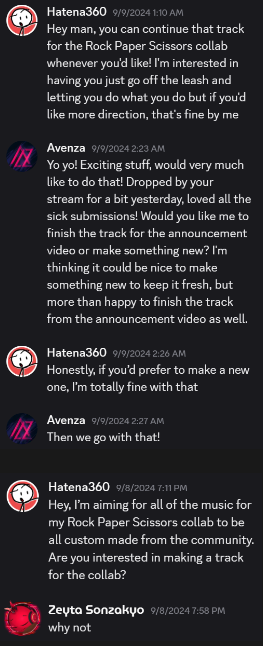
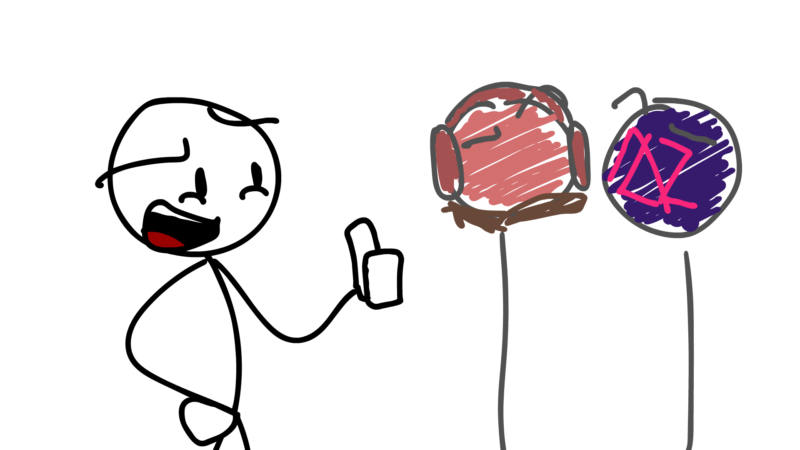
I struggled with the Stone Collab to find a good musical identity because the usual EDM-style music I lean on didn’t fit the calm and vibe-y aesthetic I was going for so I searched the YouTube music library for somewhere around 10 hours total to find some good acoustic guitar options that didn’t sound like they belonged in a beer commercial. I ended up finding some pretty good tracks but it’s difficult when you don’t have a licensing budget. This is why I wanted to host a secondary collab for musicians in the RPS collab. It would allow me to find and promote musicians in the community while not having to worry about copyright and licensing. It was perfect! Except there were 2 major issues. The first issue was that there weren’t enough musicians in the community that are up to the skill level and quality I expected for the collab. The second issue was that the musicians I did get to participate would make good tracks, but I didn’t have any control over the music by the end of their process. Avenza and Zeyta Sonzakyo ended up participating in the custom music for this collab and what they produced was great, but I’d be lying if I said I would have chosen those had I known what they would end up sounding like in the end. Don’t get me wrong they’re still awesome, I’m just super picky. I also wanted to compose a track for the collab myself but we’ll get to that later.
It has since been roughly 2 years since they made these tracks and they were very patient with me to get this collab done. Please go show them some love by listening to their music.
Patching the Gaps
Something consistent you’ll see in my compilation style are “custom entries”. These are entries that I need to have made custom because there isn’t an entry that fits in the spot. This usually happens at the later stages of production when I’m running out of entries to fill in the gaps between other entries but this time I had failed to compensate for something simple: Intros and outros.
Notice how every track starts with someone instantly getting defeated. You don’t get to see their victory animation but you get to see them lose. Same thing with the ending of each track. You don’t get to see the final person’s defeat. I had somehow completely failed to anticipate this when preparing the collab despite having run into the same issue during the test compilation. We were too late in production to change things now so I had to make a decision. Should I use people’s entries who didn’t quite get confirmed to be in the collab but not use parts of their animation, or should I have people make animations entirely custom for these bits? I thought that only using portions of people’s entries to fill in these spots would be disrespectful to the animators who worked on them so I decided to use my “custom entries” system I had used in the Stuntman series.
Usually this would only be no more than 10 extra entries at most, but this time there were over 30 animations that needed to be made to fill in the gaps of intros, outros, missing portions in the middle of tracks, and intermission entries due to their format-breaking complexity. I originally created a whole new Discord server for this process where I invited animators to make custom entries for the collab, but I learned that even if they want to work with me, if I make them jump through hoops to participate then they still won’t participate. It doesn’t matter if I’m the “collab guy”, these are still animators looking for something quick and fun to do so I need to make it as easy as possible for them to participate. I
ended up directly asking people in DMs if they wanted to make a quick part, then gave them options. Once they chose what they wanted to do, I would send them the files in dms and try to give them instructions form there. This proved to be more efficient, but with how many people I was talking to I ended up getting pretty messy with my instructions with some of them and resulted in me having to ask them to do their entries differently. These entries were being made from around October of 2024 up until June of 2026, just 1 month before the collab was released.
There were a number of entries that either didn’t use sound effects, or didn’t use them well. This meant I needed to either add them in myself or redo them entirely. It’s normal for me to add some sounds to certain entries if they feel quiet at times, but it’s become a normal thing for me to have to completely finish their soundwork for them. The reason isn’t because these animators forgot to add sounds, but because I let them. I figured that in order to get as many entries as possible, I needed to lower the skill barrier. Animators are animators, not sound designers so by allowing them to submit without soundwork, I could get more entries. This has bitten me in the ass collab after collab because it takes so much more time than it needs to. Going forward I will not be accepting any entries to my
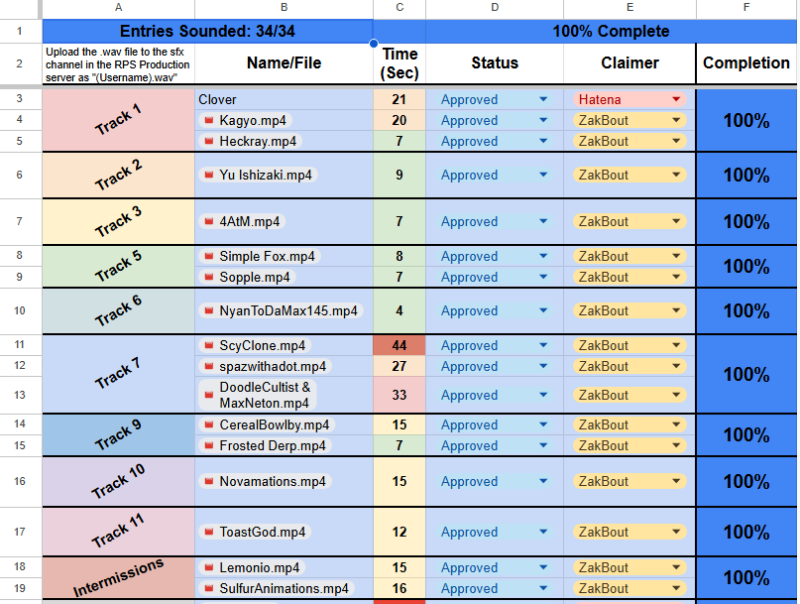
future collabs unless they have sound effects unless they are REALLY good. I’ve elicited help for this process in my past collabs but this time I invited ZakBout who helped me on the Stone Collab. I had developed a pretty good spreadsheet system for this process so I pretty much copied that right over from the Stone Collab. I invited another person to help but Zak knocked them out of the park to the point there were none left for me or the other person to do! Big shout out to Zak, he saved my ass on this one as some of those didn’t get finished until a week before release.
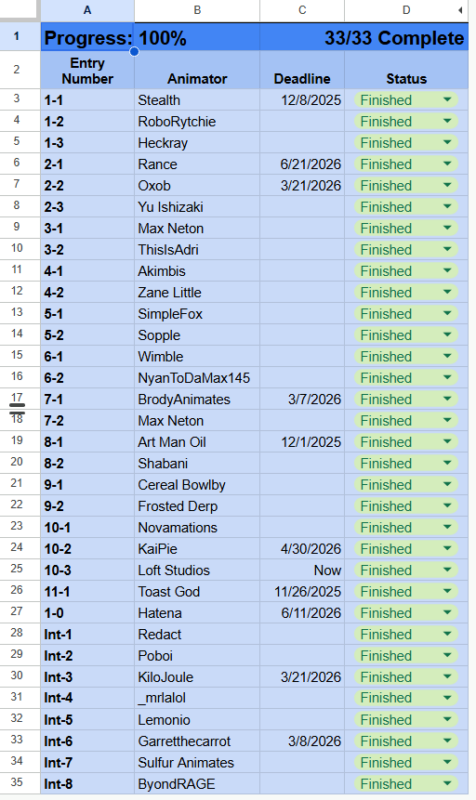
I had cycled through a few different deadline systems during this process since animators need to be pushed to finish things on time. I tried keeping track in Trello, a list-tracking website that I ended up using to map out everything I had left to do for the collab, but it didn’t feel very efficient. I then tried Google Calendar which worked for a while, but I don’t really use Google Calendar so I would end up forgetting to check pretty often. I eventually landed on implementing a deadline system on a global spreadsheet where I was keeping track of things like entries that needed to be sounded, revisions that would need to be made, and most importantly the cutscenes.
True Scope Creep
I have a philosophy when creating things where in order to challenge myself to keep improving and innovating, I should put in all of my effort into a project to make it feel impossible to surpass. I’ve found it to be effective in pushing me and helping me find my limits in what I do and don’t enjoy doing. My last major collab, Stuntman 3, had an amazing intro sequence co-directed by my friend UnderMineBlox, and ended with small bits of a story featuring an older character I simply named “The hero” at the time. I thought adding more story elements would add a level of depth I hadn’t explored at the time. I wasn’t sure what I would do for RPS but since it was looking to be pretty long already with 11 featured tracks, I needed the ending to be a big display of effort to reward the viewers for staying until the end. It’s easy to simply use up all of the entries and try to save one big grand one for last, but I felt I needed to do something much more complex.
My first idea was to host a second joint-based collab inspired from Shuriken255’s “Deadly Runners” at the end where a bunch of animators’ characters would run up a pyramid to try and reach the trophy at the top, declaring themselves the winner of Rock Paper Scissors. They would have to avoid or block a bunch of rocks, paper, and scissors on their way up in creative ways all while incorporating a synced element like I’m known for doing. I started planning & producing this version of the end under the name “RPS: Extended” with plans to start reaching out to potential animators, but I eventually took a step back and realized that this was too much work to pursue. People might find it strange and confusing if the format of the collab completely changes in the end for seemingly no reason and trying to mold a story around it proved to be messy, so I scrapped the idea and scaled it back to just a normal collab with nothing special.
I should have stopped there.
I continued to feel like the ending wasn’t enough and there needed to be something with a little more… umph! I had been starting to get the hang of script writing so my mind was already in story mode, trying to come up with stories wherever I could tell them to help improve that skill. Storywriting has proven to be one of the most difficult things to learn how to do. Like many things it’s easy to write a story, but it’s hard to write a good story. I looked back on Stuntman 3 as my greatest work of art and reflected on the storybuilding aspect of it. Was there a way I could expand on this? This hero character seems random in the context of this series, but I could build his character a lot better if I gave him more screen time.
On February 22nd of 2025, Lunsar and Shabani had just released their collabs Freefall 3 & To Catch a Butterfly along with a couple other community projects creating the now well renowned “Stick Figure Day”. Around this time I was thinking about this story about this older character from Stuntman 3 and was inspired by the cutscenes Lunsar had put into his collab. Could I add cutscenes to RPS in a way that blends well with the structure and concept of the collab? Was there a theme I could find to tie it all together? What would this world look like? My mind was racing with ideas on how to make this work.
The main inspiration for the cutscenes in RPS
Rock Paper Scissors is a game about luck. Every round is a gamble. There’s no strategy. If you had attached money to it, you could easily turn it into a game about gambling. I’m pretty “purist” when it comes to a lot of things and I don’t often take chances. I never found even legal drugs like weed or cigarettes appealing, I have no interest in alcohol, and you’d sooner find me dead than in a casino gambling. I’m a very stubborn person so while I know all of this in moderation is fine, I’d rather stay away from it all. I’ve seen and heard the horror stories that come from abuse in all of these concepts that have scared me away from even considering trying any of them. I’m not against others doing these things, they’re just not for me. So long as you’re not hurting yourself or anybody else, then go for it. I realized that I could turn RPS into a cautionary tale of this slippery slope and how easy it is to risk everything for a small moment of adrenaline. I wanted the energy to feel dark and dangerous, further encouraging the idea that these kinds of things can be very dangerous in the wrong environment. I wanted the protagonist to be imperfect and desperate to justify why they’re here in the first place. They should be a bright color with a fun energy that feels like they’ve gotten themselves into the wrong position. This is how Clover was born.
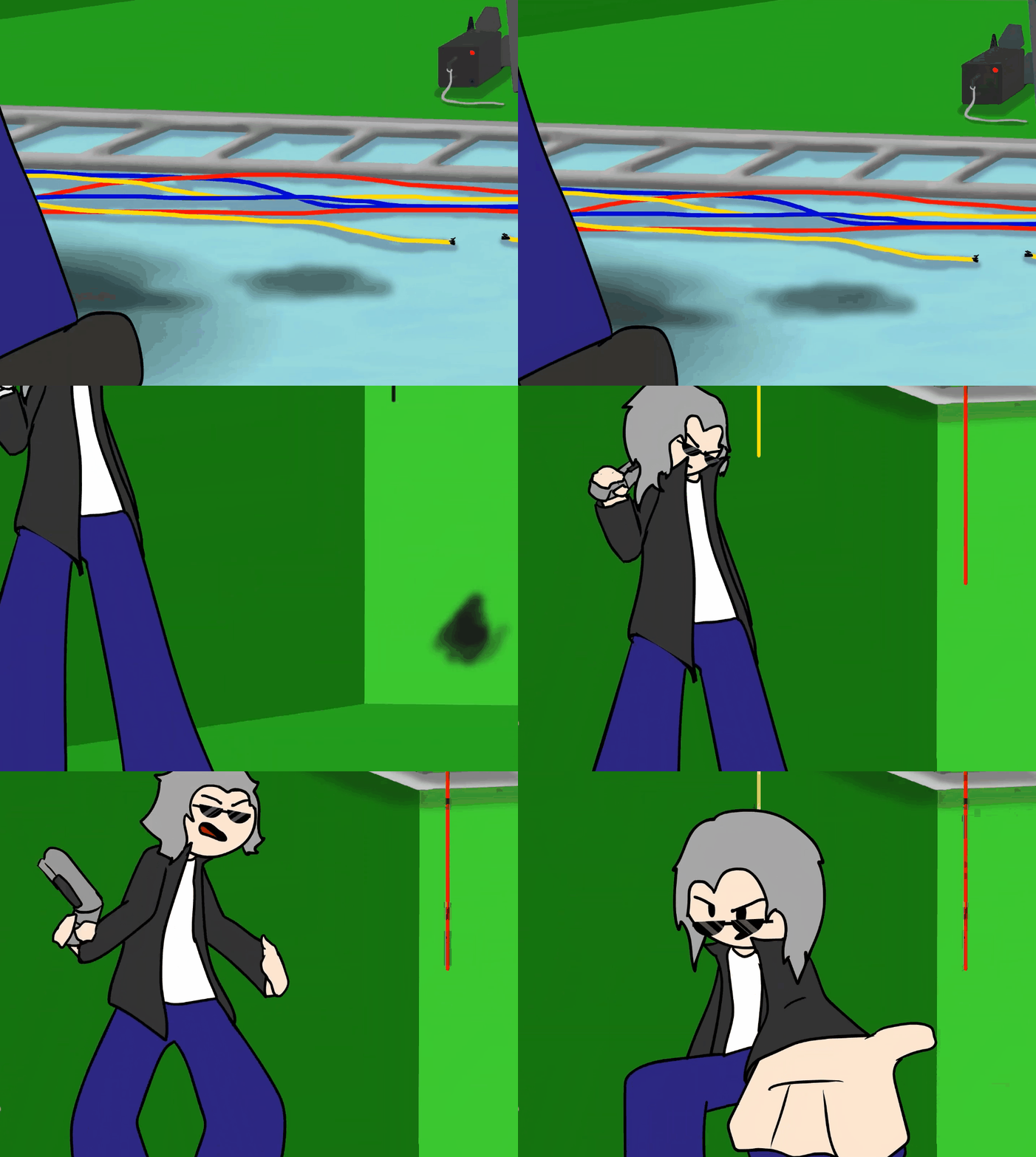
I decided to bring back the hero from Stuntman 3 as the antagonist for a few reasons. I wanted to put a spin on our perception of the character by painting him in a bad light while slowly introducing moments that would make him redeem himself in the eyes of the viewers and offer a chance to help Clover instead of taking advantage of her. I wanted to show that even when you’re at your lowest, there’s always someone who can help you out. I also brought him back to add on to the world building from Stuntman 3 to imply that this world is more than a one-off experience.
There’s potential in this world and a lot of stories can be told in it if I play my cards right. I wanted to create a collab “universe” in a way where I can tell many stories in future collabs that take place in the same world that can build off of each other. Having this story only feature a stick figure and a humanoid would feel off, so I decided to make our hero from Stuntman 3, who I named “Cut” at this point, play poker with 2 other characters of different styles to support the idea that any style can exist in this world, just like in “The Amazing World of Gumball”. I added the red stickman from another one of my collabs, “Big Ol’ Synced Joint”, to support the idea that older collabs can take place in this world. I created the tall, geometric puppet character to showcase the difference in styles each character can have. This character was inspired by the paper-puppet style from Piemations and was actually supposed to have a paper texture on him to further nod to that inspiration but by the time cutscenes were almost done, I scrapped this idea in favor of time. You can still see this in the concept art though.
The other two characters that come in later are Hoodlum and Brick. They are filling in the role of Clover’s motivation. I wanted their styles to be different initially, but I didn’t have the skills to explore more humanoid styles and figured it would be earlier during production to apply the same rules we had for Cut. While they may play a larger part of an overarching story, their motivations are intentionally unclear for now. They are here purely to give Clover a reason to be in this basement and making the poor decisions we see her make.
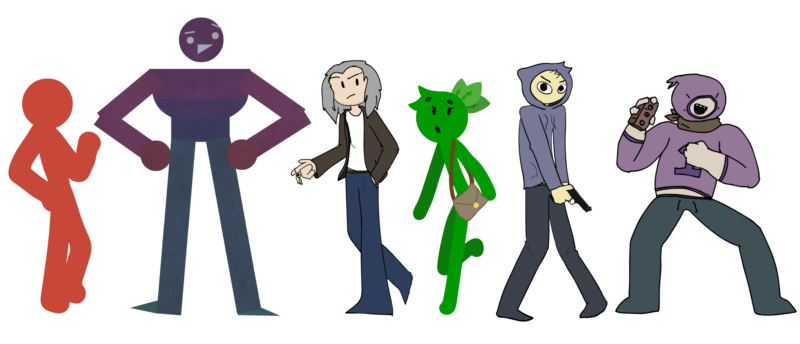
Concept art (from left to right) of Guy 1 (BOSJ), Stephen, Cut, Clover, Brick, & Hoodlum
Collab cutscenes are well known for being skippable and not having much to say. Most of them don’t convince the viewer that it’s a necessary part of the experience since they’re not given a reason to care. People watch collabs to see what cool entries and submissions people have animated, they didn’t come for you. They don’t care about your story. I think some have gotten close to making cutscenes in collabs feel natural and necessary to the experience, Shabani being the closest in “Beach Day”, but even then I found myself and others skipping the cutscenes just to get to the meat of the collab. If I were to write a story into this collab, I couldn’t just write a story and call it a day. I have to give viewers a reason to care and hook them from the start. This is why we start with an action sequence. I then introduce the stakes between the main 2 characters to convince the viewer to stay interested, and then I transition us into the collab itself with another action sequence depicting Clover somehow crossing into another supernatural world. We later establish that this is daydreaming since I didn’t want to answer it from the get-go. Leaving the viewer with questions can be a useful tool to help keep engagement. If I never explained it, it would only raise more questions and cause the viewers to be confused and miss the lesson I’m trying to tell them. I could have incorporated this explanation better of course, but it works to serve its purpose.
One of the challenges was the duration. I used each cutscene to show them finishing and preparing another round of rock paper scissors. There were a lot of tracks to work around, so I had to employ some lazy tricks to extend the story as much as I could. For the most part I was able to raise the stakes in each cutscene to maintain interest, but there were some where I had to simply stall for time. This is the weakest part of the story but I think they still work well to hold the tension we should be feeling for Clover, especially near the end.
The Voices Defining Luck
The script was written in 2 days. I had never written dialogue so… easily before, though it was still a challenge. Writing dialogue is one of the most difficult things to write in any story. It’s so easy to make things sound unnatural and fake, which breaks the immersion. I could have used text and speech bubbles for the characters to speak with, but nobody wants to read. It would be far more engaging if they actually spoke, but that presented a much larger challenge than writing dialogue alone.
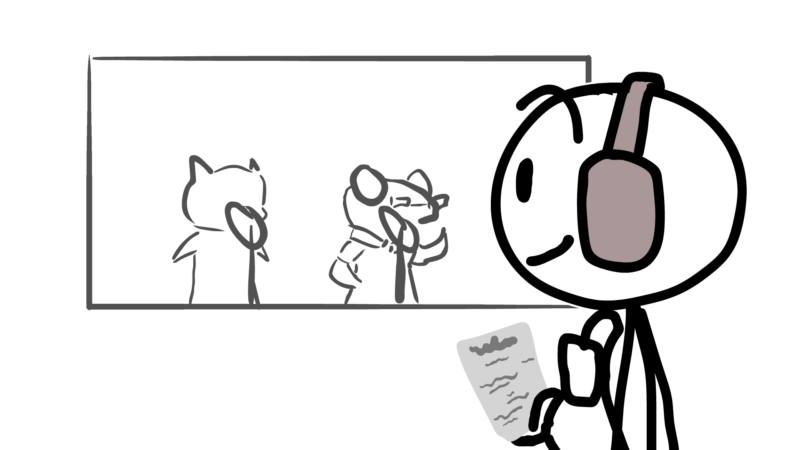
Something you’ll notice in this community is that we tend to lean on text for dialogue. We do this because it’s easy and cheap. Voice actors aren’t very common around here since we’re mostly animators and illustrators. We let our art speak for itself and rarely choose to use actual voices. There have been some who have tried, but they always end up feeling… off. Unnatural, as if these characters have never spoken to another person a day in their life. Why does this happen? Why is this so hard for so many people to get right? Are my cutscenes going to sound the same way?
My suspicion is that most animators who want to use voice acting in their projects end up using themselves and their friends to voice act. These people usually have never done voice acting before and don’t have the skills necessary to do so, but on top of this they’re often not given explicit direction. They’ll likely give their friends the script and tell them to record their lines and that’s it. There’s no involvement past that and I think that’s where most people end up with crappy voice acting. In order to avoid this, I used a few tricks I had heard about and applied a lot of my own personal creative philosophies to this process.
The first trick is not to cast someone for a role they need to be molded into. Cast someone whose voice is already close to what you want. If they sound like the character you’re casting them for, they’ll have a much easier time using their voice to play that character. BestFrog had already voiced Cut in Stuntman 3 so he was already locked into that character, but I still didn’t really know what Clover was supposed to sound like. I hunted for voice actors and landed on one I found on Twitter, but due to scheduling conflicts we couldn’t make it work. I had decided to source from within my own network instead and asked Diang0 if she was interested since she’s always so full of energy and excitement with a background of performing on livestreams as a v-tuber, and she gracefully accepted the role.
The second trick is to show them what they should sound like. Either providing a reference to another character’s performance in a show or movie can help, but I created storyboards for every cutscene and voiced every character’s lines in the way I thought they should be performed. I would then give this to the voice actors before scheduling a voice call so they could familiarize themselves with my expectations and what the energy should feel like.
(Full version of this video on Patreon.)
The third trick is to create an environment where their dialogue can feel most natural. You’ll see a lot of shows do table reads where all of the actors will read the script at a table and play the role of their characters. To recreate this, I had tried to schedule a call with my voice actors to record their lines at the same time so they could naturally bounce off of each other, but they unfortunately couldn’t meet at the same time when I needed them to. I instead called them separately and played the role of the opposite character to maintain the natural feel of the dialogue. There’s a lot of nuance in voice acting that you can’t pick up on if you’re acting on your own, so I find it incredibly helpful to give them an environment where they can respond to someone in real time. You don’t NEED to do this of course, but I found this to be very helpful.
The last trick was more of a philosophy I held when letting my voice actors play their characters. For these actors to make their roles feel as natural as possible, I let them own their characters in a way. They need to be able to make creative decisions for themselves that make the character feel more consistent and real. Clover is less of my character and more of Diang0’s since in a way, they are the same. Obviously there’s a lot of differences between them, but Diang0’s experiences have influenced her voice and performance to sound a certain way and so in my opinion, Clover needs to be the same.
With the voices done, I could finally replace my shitty scratch vocals with the final vocals and move onto the visual stage of production.
Creating A Pipeline
Storyboards worked well with bringing context to the voice actors but based on the amount of animation that was needed to do for the cutscenes, I needed a team of artists to help me finish this project within a reasonable time since production had been going on for well over a year now. I started with turning the storyboards into moving animatics to better sell the composition, camera movements, and mood / interactions with the characters. Bringing an early rough stage of movement into the process better helps define my vision and how things should be laid out for future polishing stages.
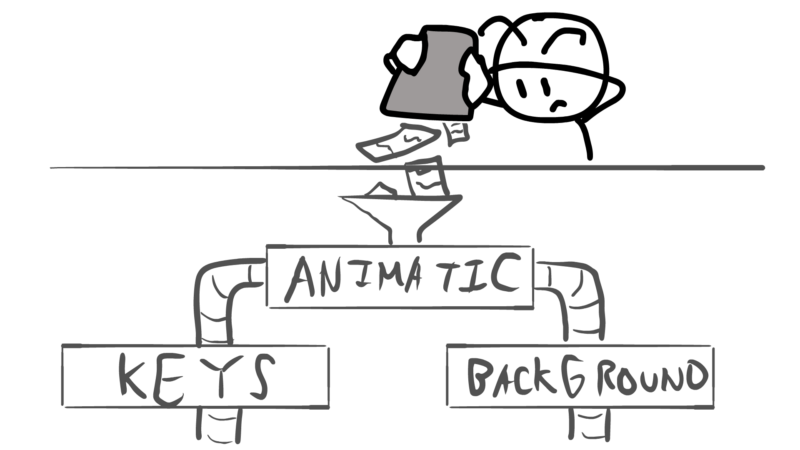
It was also important to plan reusable BGs during this stage so that we could be efficient with out BG placement and lower the amount of work required by the background artists, but with some of the fight scenes in the end that number ended up bloating the total BG count to over 50 custom backgrounds. I worked with NyanToDaMax145 to develop a simple and repeatable style to apply to all backgrounds during production. We ended up using Balanar’s “Boogeyman” animation as inspiration for this style since it felt quick to do while adding enough detail to effectively tell the audience where we are. Lux made a wonderful video showing off some of this process!
Once the animatic was done, it would split off into several different kinds of key animation. Key animation is where we focus on creating the main poses that build each movement. For some characters like Clover and Stephen, it was pretty simple since their designs were already simple to begin with. Characters like Cut however would get line art only with no color. I had a team dedicated to just full body characters since most of the team was composed of stick figure animators. It worked well when they were available, but finding enough of them to complete the
necessary work was more challenging. I would reach out to some animators and ask if they could draw Cut, Brick, and Hoodlum and if they did well, they would be given a scene to test. Oftentimes people would work on 1 or 2 scenes then take a break, or leave the team to focus on other projects or other life responsibilities.
Sometimes we would wait for all of the key animation for every character to be finished before moving onto final animation, but depending on everyone’s availability we would get a head start on final animation for some characters and then return to key animation later so we could have as many files being worked on at the same time. Final animation requires us to add in-betweens to each movement and make them feel truly alive. For the full body characters, this also means adding color. One major issue I found was that there were only 2 people who could replicate my face and lip sync style to some degree, but most people were told to leave it to me. I ended up doing 90% of the lip sync and most of the facial animation for Clover. It’s a good thing I love facial animation because boy did I do A LOT of it.
Once the final animation was fully completed, I would add in the backgrounds and assets and implement other changes I saw necessary. This is usually when I would tackle facial animation and lip sync as well. With the visuals complete, I could then add sound effects to the cutscenes and start directing Jojo on how we would score the cutscenes. More on that later.
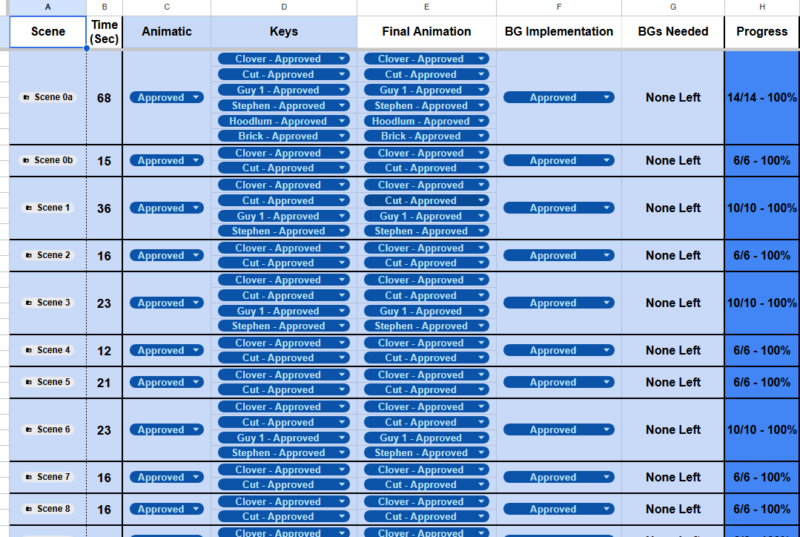
I made a custom spreadsheet to track progress that I ended up being very happy with. It took some iterating but the final result turned out to be very efficient when tracking who has what file and what they were doing, as well as who was available and what they could work on. I also used this spreadsheet for tracking backgrounds, assets, sound effects, revisions, and custom entries . It was pretty powerful by the end! It can use some automation features to make it faster but it was already a great visualizer of progress!
I also had some special guest animators for the first time to work on the cutscene action sequences! ByondRAGE (aka TNTL) worked on the first one in the beginning of the animation where we would see Clover start to daydream as we transition into the first track of the collab. Rojackie worked on the choreography for the ending daydream fight between Clover and Cut and ended up helping us finish the final animation for Cut as well. Lastly, TJB worked on the final fight featuring everybody. I made some tweaks to the choreography but she definitely built the crucial skeleton for what would end up being an epic ending sequence. The difficulty from this final fight came from Clover’s supposed “luck”. We wanted to showcase her trying to fight with Cut but everything she does seems to work accidentally. She could be lucky, or she could be clumsy. I think it was important to leave it vague and let the viewer wonder if it really is a power of hers or not.
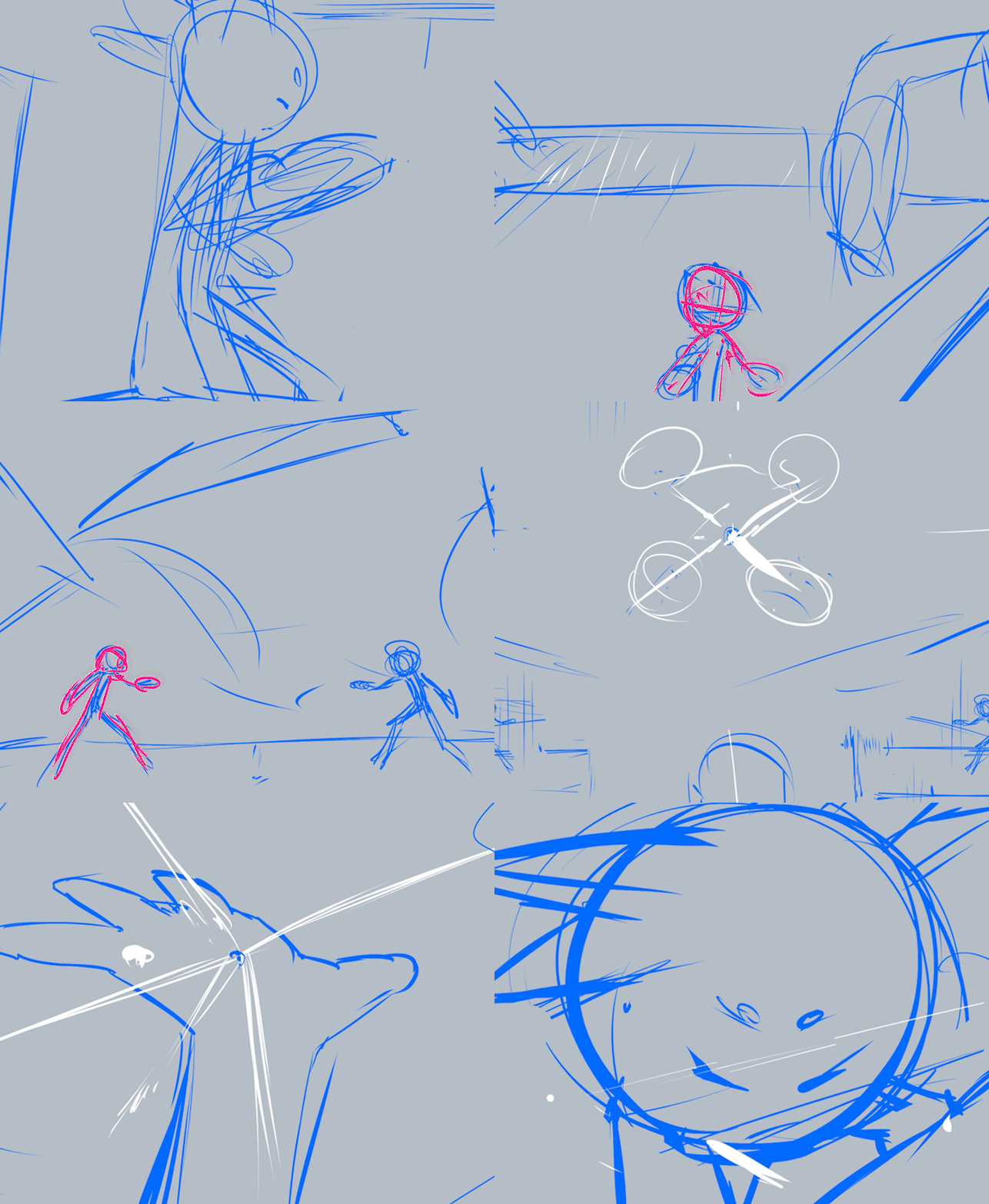
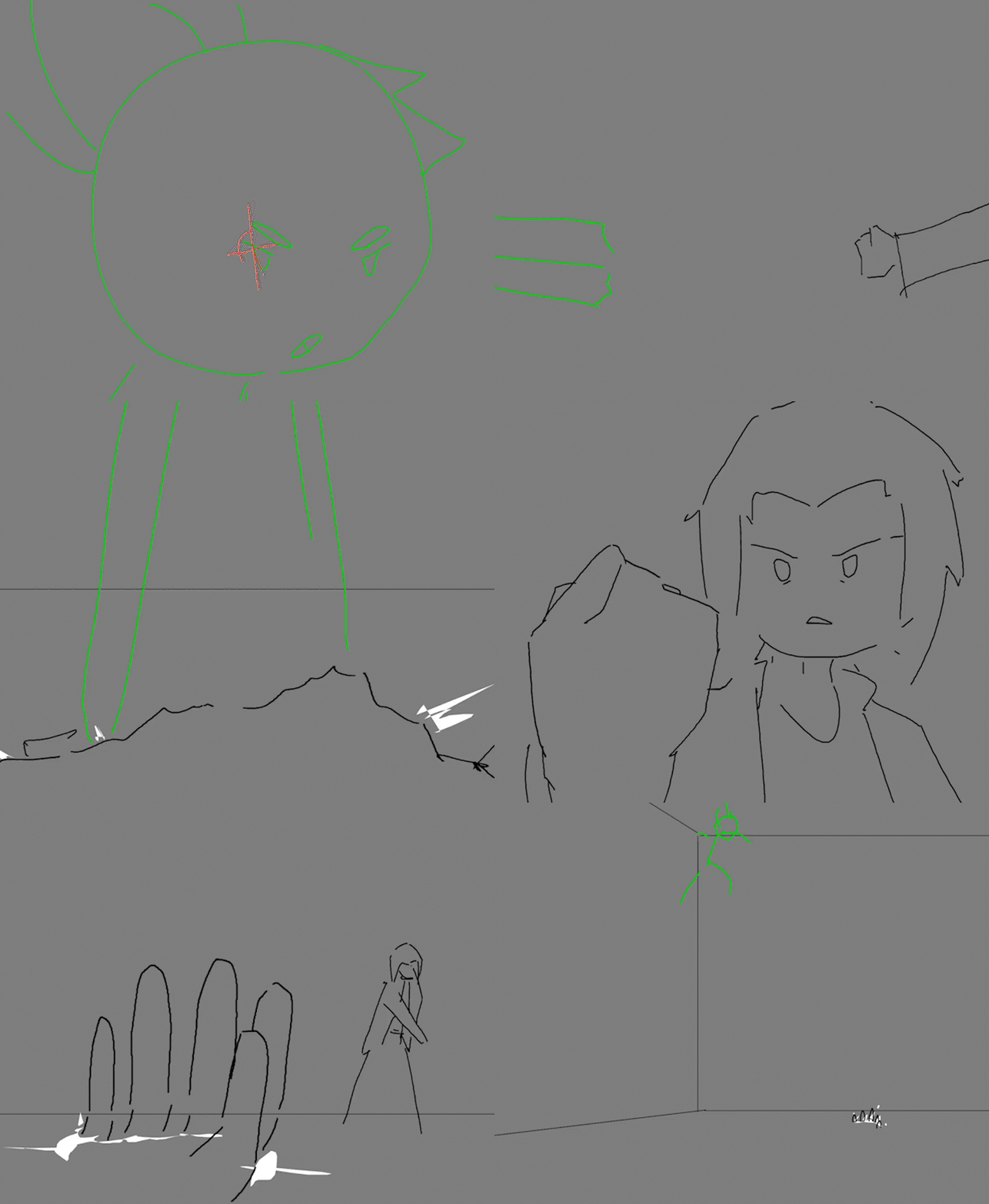
Animatics (from left to right) by ByondRAGE, Rojackie, & TJB
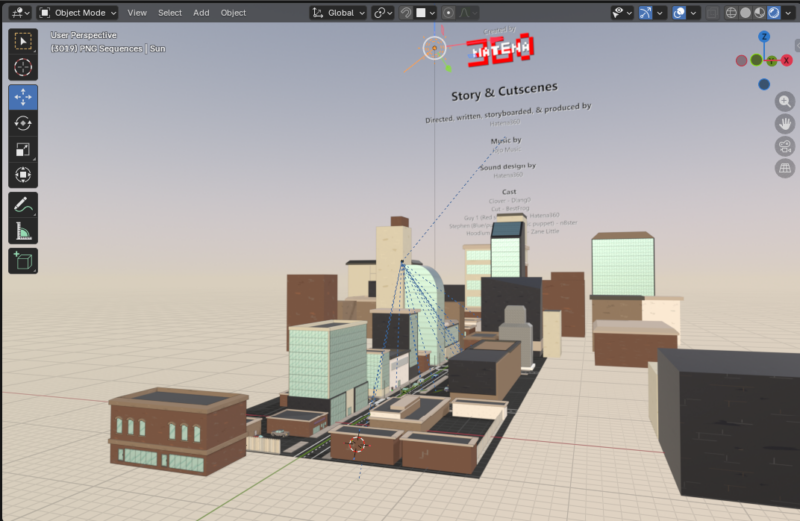
The ending scene in the city was especially challenging since I didn’t want any help with the background. I decided to take on the daunting task of learning Blender so I could build the city, move the camera, create the textures, and move the cars. The only things I didn’t do were animating the pedestrians (those were members of the team btw), modeling the cars, and the trees being done by Lux. Other than that, I used this opportunity to learn a lot about Blender and while it’s FAR from perfect, people more experienced in Blender told me that it was already really impressive having been my first project with the software. I remember BrodyAnimates asking me why I didn’t get someone else to just do it for me and I told him it’s just an excuse to learn something new.
I was hopeful that bringing on people to help would speed things up and while it did, it was not as effective as I had hoped. I wish I could have paid those who helped with this project but as I’m living alone in a Colorado home, almost all of my income goes straight back into rent, utilities, insurance, and food meaning there’s not a whole lot left to put into the project. Everybody who participated in the cutscenes did an extremely generous amount of volunteer work and I hope I provided a fun and useful environment for them all. If my videos do well enough in the future then I would love to pay these people for their time but until then I will be pushing my videos to perform better on the YouTube algorithm as well as pushing more direct outlets to help me such as Patreon. I won’t push much here but if you are interested, you know the deal.
I also want to address a comment I had heard when discussing the payment issues on Episode 105 of the Dojocast. A belief is that those who help with the cutscenes should not get paid since none of the collab’s participants got paid, making it unfair for the participants. While I understand the argument, I disagree. The participants of the collab don’t get paid because they’re not being directly asked to help with specific directions within my vision. These collabs act as one big advertisement for animators and artists since their names are plastered over their part to ensure they get properly credited in a simple and organized manner that’s easy for viewers to see. People who have helped with the cutscenes have to follow a lot more directions such as matching certain styles, following certain rules, and meeting deadlines. Since they’re currently not getting paid, they’re allowed to show people what they’re working on through discord voice chats and they can leave production at any time. Nobody is obligated to stay and work with me and I appreciate everyone who participated in this deeper stage of production so please do give them all the attention they deserve. This collab would not have happened if it weren’t for them.
RPS Cutscene Production Team
Animation
Guest Animators
Background Artists
The Custom Score
Another thing that Shabani did well with Beach Day especially was the custom score done by another friend of mine, Sthom. I was surprised to learn that Sthom wasn’t really given much if any direction for Beach Day so when I asked him if he wanted to score the cutscenes for RPS, I wanted to give him a lot more direction.
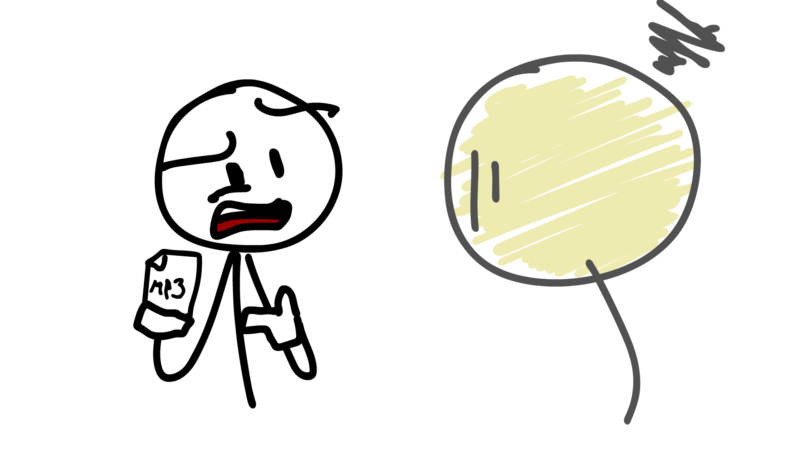
There’s a lot of ways you can use music to enhance a visual story. The instruments you use and the energy they create all need to be carefully curated to assist the story. I compiled all of the cutscenes into a video with descriptions of how I wanted the score to come together, the kind of instruments I wanted to use, the energy I was trying to create, and why I chose what I chose. I sent this to Sthom so he could see my vision and see if he could do what I was asking for. Sthom had made some progress for the intro and some of the other cutscenes and I liked where he was going, but
he ultimately left due to not having the confidence or the library of instruments to effectively do what needed to be done.
At this point we were 2-3 months away from releasing the animation and I needed to find a replacement quickly. I had heard some music from another community member, Jojo Music. I heard his work in DJdheeik’s “Mirror Collab” which was a small amount of work, but I decided to ask him if he was interested and we’d see how things go. I showed him the same video I sent Sthom and he seemed interested, so he started working on the intro scene’s score.
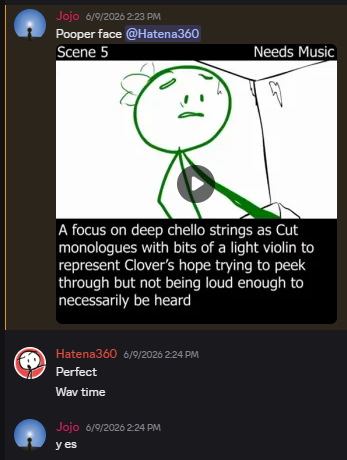
Admittedly I wasn’t sold at first but we kept going back and forth and making specific tweaks to make it as perfect as possible. I was so adamant about perfecting the intro because if the music isn’t compelling and assisting with the visuals to enhance the viewing experience, viewers are much more likely to skip it or watch something else entirely. Something that took a lot of explaining was the violin. I wanted the music to focus on stringed instruments since they hold a wide range of emotions depending on how you use them, more so than others in my opinion. You could use lighter and higher strums and plucks to carry a fun and hopeful tone, you could use quicker and unsteady notes to carry a messy and stressful tone, you can use lower & longer notes to make things feel dangerous, and so on.
Clover’s instrument was a violin because I wanted her to feel hopeful and wholesome. You can use it to create uneasy emotions but it’s mostly associated with happy feelings. Cut’s instrument was a cello since from Clover’s perspective, Cut is the bad guy and a challenge she needed to overcome, so deeper strums and fill the background with a low, growling hum felt fitting.
Once the first scene was finished, the rest of the scoring went pretty smoothly. Jojo got to a point where his first pass on a scene’s music would be approved since he got the hang of it pretty quickly. He began to understand what I wanted and even got to a point where I was telling him to ignore old notes since I trusted his vision better than mine. He even took the liberty of adding a motif for Clover’s mom that he then later implemented into the scene where Cut alludes to the idea of Clover doing this for a loved one who’s in trouble. Go back and see if you can hear it!
The Never-Ending Crunch
I had taken significant breaks from RPS to work on other projects due to an old strategy I used to avoid creative burnout. This strategy was the “Work on so many things you don’t every finish any of them” strategy and worked well for avoiding burnout, but it was also one of the main reasons RPS took so long to finish. Whenever I would feel demotivated from the project, I would do something else instead and with the sheer amount of work needed to be done, I would constantly put off working on RPS. I had hosted 5 collabs in the time it took to finish RPS both of my own with Dojocast and in collaboration with others such as raxflipnote & ZaneLittle. One of those was “Dojo’s Got Talent” which was wrapped up in September of 2025. After that one finished I made it known that I would then be shifting my full attention toward finishing RPS instead of avoiding it.
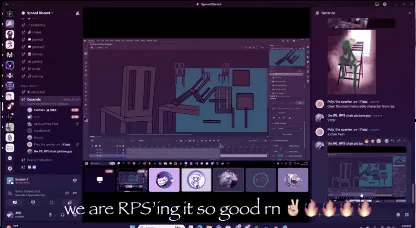
I created a group chat to officially start organizing the animators and background artists for the cutscenes since I originally wanted the team to be small. Eventually I had to create a Discord server since the team would eventually grow to 24 people and group chats can only hold 10 people. This is when I would make the spreadsheet and start to communicate with the team heavily to ensure things were consistently & efficiently being worked on. We had been working pretty closely and very consistently, but come January of 2026 I had to step away for a brief period.
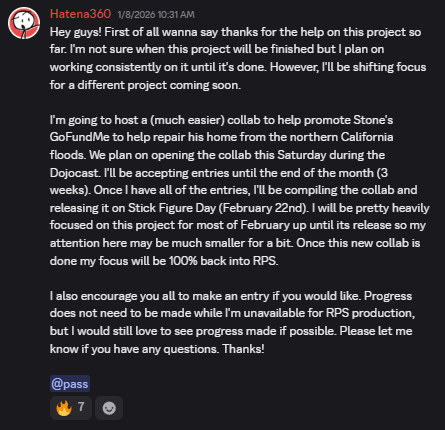
Cohost of the Dojocast and close friend of mine, Stone, unfortunately had his house flooded in late December and was struggling to fund the cleaning & reconstruction of his home. It was sad and scary but if you want to hear more about this then you can hear the whole story about it in Episode 95 of the Dojocast. I wanted to help raise funds for him so I made a GoFundMe for him and decided to host a collab to help market it. Because of this I had to step away from the RPS team which caused production to halt. If the leader of a project stops working, then everybody else has no reason to continue so if I wasn’t working on RPS, nobody else was.
Once I returned I was able to get everybody back on board and continued to look for even more people to help. I would receive some messages from people asking directly to help out but by that point I really needed help with the full body characters since I can’t draw them quite yet. I would send them the reference sheets for
these characters and ask them to try and draw them as accurately as possible. I had to deny a few people because the style was just too noticeably different.
Lux came onto the team very late into production but quickly made the most backgrounds. They surprised me by their output and I eventually just let them claim BGs whenever they wanted since that proved to be more efficient and I usually had no notes.
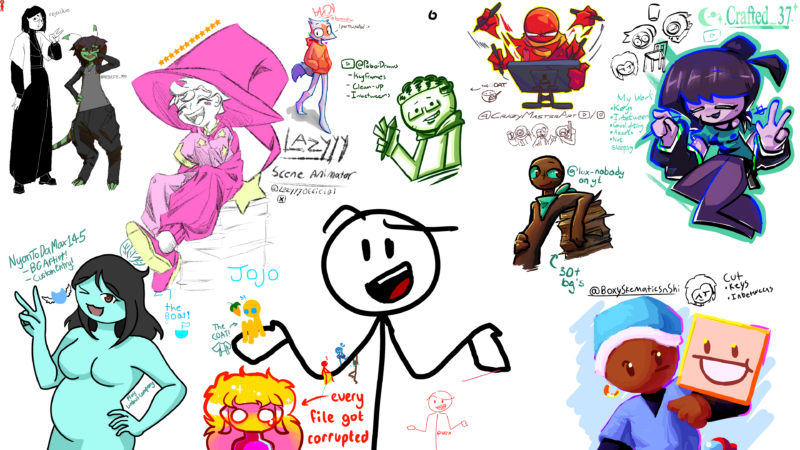
The final fight scene easily took the longest to finish. I have to give a lot of praise to Crafted37 who practically led the full body animation, asset animation, and background implementation for this final fight scene. I made a 3D turnaround asset for Cut’s gun but there were some instances where it wouldn’t be fully effective so they had to redraw it sometimes. They also ended up manually drawing and animating other assets like the cup, filing cabinet, and all of the chairs. They put in a lot of time and effort into this scene, even recruiting the final member of the team,
Hamon, to help finish this scene. Crazy Master was also heavily involved in this scene. This final fight was the very last thing finished, just the night before RPS premiered to the public.
Everybody on the production team did a wonderful job and again, I can’t thank them enough. This collab would not have happened if it weren’t for them.
I Quit
Once I dedicated all of my free time to RPS, I treated it like my second full-time job. Every day I would start working for Alan Becker, then once I clocked out I started working for RPS. Trying to fit in food, sleep, and family in this 10 month period was very difficult.
I had tried meal services like HelloFresh to make cooking meals easier but they still took up too much time. They say a meal will take “30 minutes to finish” and would end up taking at least an hour. This would also be very tiring and wouldn’t leave me with much more energy for the day so I ended up giving up and ordering a lot of food, or just making lazy meals that would take 10 minutes to eat. This was definitely not the healthiest decision and probably didn’t help my energy either, but I figured that food was food and the more time I could save for working, the better.
I already had issues with setting aside time to spend with my family, especially since I now live alone and away from my parent’s place. We have a weekly family dinner or event every week and there ended up being a lot of weeks where I would bail just to work on RPS. My family would always be asking to do things with me but I personally don’t find much fun outside of work, yet it got to a point where work was slowly killing me. I let bad health habits take over just for the sake of convenience and when I had friends over, they would just sit in my office and watch me work until they got bored and decided to leave.
On top of this, I ended up breaking up with my girlfriend part-way through production. It wasn’t a one-sided issue, it was very mutual and we’re still close friends. This project showed me that I would rather spend my time working on an animation instead of a relationship since whenever we went out together, I would just be wishing I was home. I feel bad that I did that to her but she knows the way I feel and how I beat myself up over stuff like this. This break up took a heavy toll on me for a long time and I’ve only recently truly gotten over it, though it’s only because I’ve come to terms with the fact that I’ll likely never find someone who could pry me away from my work.
I also don’t sleep very well in general, but this project really took a mental and physical toll on me. It ruined my sleep schedule. I’m lucky to get 5 hours of sleep a night now which is not ideal, and I really do feel the consequences most day now. Insomnia I hear is something that runs in my family, and it sounds like it’s usually caused by stress so I’m not too surprised it’s gotten worse.
All of this to say, I nearly quit this project a few times. The first was when I realised I wasn’t having fun editing the project, and the second being in the middle of the cutscene production. There was only one reason I kept going. Any moment I wasn’t working filled me with guilt. I had been holding on to these animator’s collab entries for 2 years and throwing the project away would be an insult to their efforts and would taint their trust in me to complete another project. Nobody wants to work on something they suspect won’t ever be released, but by the time I would have finished this project their entries would no longer be fully representative of their skills and who they are. There was one last time I had considered quitting, and that was with my own custom track “Four Leaf Clover” .
I have been passionate about making music for a long time, but I started taking it somewhat seriously in 2021. I’m only a hobbyist so I don’t intend to take it to a professional level and I never learned what music theory is. Despite this, I wanted to challenge myself to make something I would be proud enough to put on one of my collabs. I’ve made some competent music before but nothing I would ever use for something I truly cared about.
I ended up writing the original song in just a few hours which is normal for my song writing process. I was happy with the melody and generally ok with the lyrics, but I was hoping that when I began to produce it it would all come together. The original track was called “Coin Toss” and was much more direct about the themes of the message which I ended up growing to hate because it felt more like I was talking at you instead of allowing the listener to think about the song and what it really means. Something beautiful that can happen here is when someone takes a completely different message away than intended. Having a song that can tell multiple messages is just so cool to me.
Despite this, I continued to use “Coin Toss” for a long time even using it to compile the first batch of entries. I would eventually decide to try and recompose the music since it wasn’t sounding good and I was hoping redoing the instrumental would be enough to fix it, but when I was still unhappy with it I figured it was the lyrics and the melody so I rewrote the entire song into a NEW track called “Let It Ride”. This new song did not fix any of the previous issues and was instead a new version of the same thing I hated.
I kept trying to find new melodies to try and building a new chorus with it, something that could actually mean something but I kept being disappointed. Nothing was catchy and the lyrics meant nothing, so I ended up giving up on writing an original track. Unfortunately this meant I would have to find another song with the exact same song structure, bpm, and pray it’s royalty free to I can post it on YouTube without any punishments. This proved practically impossible and for one final time, led to me nearly cancelling the project. I was so demotivated at this point that I just wanted to work on literally anything except for RPS, but of course the thing that dragged me back in was the immense guilt. So many people were involved in this project for 2 years at this point and so I decided to drop the music and come back to it later.
Some time later and I don’t know how it happened, but I wrote a new melody and some lyrics to go with it. I recorded a voice memo of it and forgot about it for a week. When I came back to that recording, something new happened. It got stuck in my head. I knew this was the one, but I was so scared I would mess it all up in producing the full track. I decided to work with Yu Ishizaki to help produce a demo. I composed some basic percussion, performed some temp vocals and a bass track, and gave Ishizaki a mock-guitar track to help guide him toward what I wanted. After a few iterations, he ended up getting the right performance that tied the whole demo together proving that this was the one. We used “Big Money” from the band Friday Pilots Club as reference for performance and potential mixing, and even though the final track sounds pretty unique I have to thank this song for inspiring the original mood and feel for the final track “Four Leaf Clover”.
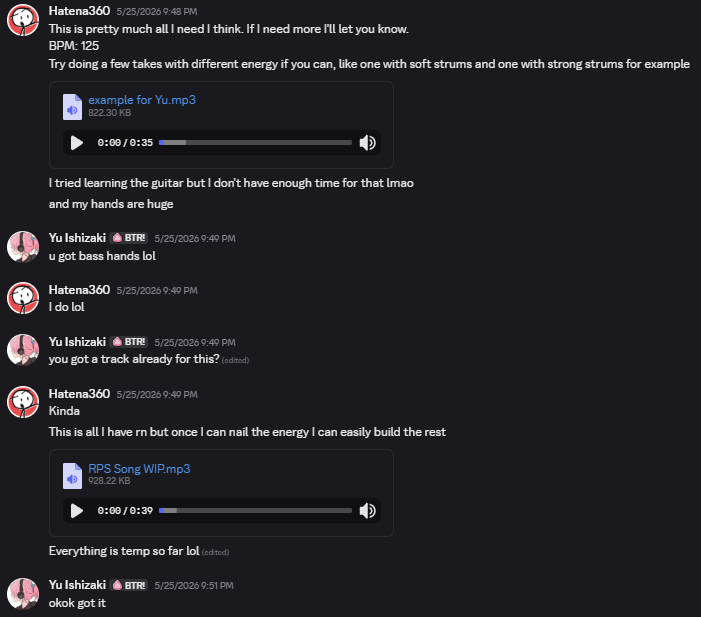
With the demo completed, I shared it with a bunch of people and they all seemed to agree that we had something cool here, which boosted my confidence back up. I wrote the rest of the song and recorded final vocals for the whole track and composed the full thing. I had Linked Winters help me with mastering the track and it was finally finished!
And Yet I Loved It All
We had a couple of private screenings, though I intended to do one in-person ar Vidcon. By the time we were about to leave for Vidcon, I just wasn’t happy with the collab’s current state as it was still heavily unfinished so I had to tell everyone in our group for the event that I couldn’t get it finished in time so there would be no private screening. Some of them were really disappointed by this which left me upset with myself. I know I had already been pushing myself to get things ready for them, but I was disappointed I didn’t work harder. Eventually I rescheduled the screening to the week before the public release where I would invite the production team, Vidcon friends, and more of my friends on Discord to see. Despite me being on very little sleep, the screening went very well and everybody loved the collab. They reacted to everything at all the right times which filled me with confidence. Raxdflipnote would end up dropping by my house on his way back home from a long California-centered trip and I showed the collab to him on my TV. PieMan also decided to drop by to watch it for the second time after the first screening.
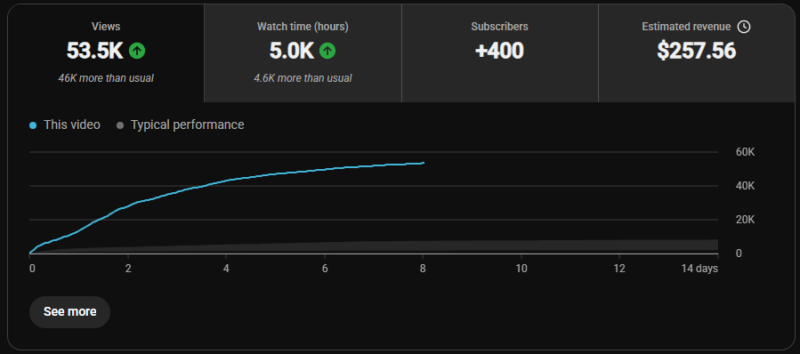
At the time of writing this it has now been one week since the premiere of the collab and while I had hoped it performed better on YouTube, it was a hit in the community. I kind of already knew it would be an instant hit but it still means so much to see all of the fan art and support for the collab. I even saw a video someone made theorizing what they think might happen with the characters from the cutscenes in future collabs which means so much to me since it tells me I did a good enough job making a story that really stuck with people. I’ve watched that video a lot lol.
My DMs on Discord were flooded for a good 3 days of people sending me compliments and congratulations on the collab’s release. I know I haven’t responded to all of them, but know I truly appreciate it. Even during the premiere I was getting tons of messages from friends and even Alan! He watched the video with his son as it was premiering and was telling me they enjoyed the Patreon ad, which I had a lot of fun making in 1 day.
The production team would constantly reassure me that what we had was special and after seeing everybody’s reactions during the private screenings, I was confident the community would love it. I just wasn’t so sure about the general YouTube audience. Whatever the numbers end up becoming, I’m done with it and have decided to let it be. If it blows up one day, then great. If not, then oh well. I’m gonna make more collabs anyway, that was never gonna change.
This collab had dragged me through hell and back. My health has deteriorated and some major changes have happened to me within these last two years. I am a completely different person from who I was back when I started this silly little idea. I will never do this concept again It was hell and hasn’t been truly fun for a long time, but that doesn’t mean I haven’t learned a lot of valuable lessons along the way.
While I’m going to be putting more focus in my mental and physical health, my sleep schedule, and spending time with friends and family, I learned a lot about leading my own production. This was far more challenging than any project I’ve worked on for Alan Becker and trust me, those can get very complicated. I’ve learned that I can’t just take the same pipeline we built for Alan’s projects since every project has its own unique structure that requires different things to be done at different times. Understanding how working with a team can be more fun and effective when you’re working with them every day turns out to be very effective as well.
The biggest lesson that I’ve learned isn’t any of that, not even the dangers of scope creep. The thing I learned is that my one big philosophy with all of my projects is what caused this collab to go through production hell. I always want to outdo myself, making it feel impossible to top myself next time. I want to push myself to do something much harder every time, but that doesn’t mean I need to be so ambitious. It’s great to be ambitious, but there’s a clear point where a line is crossed. Maybe that is scope creep, but that philosophy is what led to scope creep in the first place. I’m going to continue to add cutscenes in some of my future collabs now that I have a process that I can further refine. I don’t need to do so many things and I can put a lot of extra time into stages like preproduction to make post-production much easier and faster.
I still really love this collab. It’s a pure showing of my love and passion for my craft and I’m glad to share it with so many artists. I know what my next project will be, and I WILL still try to top this one, but I’ll manage my expectations a bit better next time. Not every collab of mine will take place in this universe, but I hope to get other collab hosts to participate in this world in a fun and meaningful way. I’d love to use this as a way to encourage these hosts to push themselves, but not too much of course. Allowing others to be part of something this big is what makes me excited. Well, there’s a lot of things about collabs that make me excited but I could talk about that for a long time, and I think I’ve yapped enough.
Thank you for making it all the way to the end and I hope you’ve found my experience entertaining, helpful, or interesting at the very least. There is no true benefit for me to write this. I don’t make any money from this. I’ve spent a large amount of time working on this blog alone, & barely anybody will read even the first chapter of this thing. The only reason I’m writing this is because I hope it will be helpful to someone who wants to do the same or similar. Learn from my mistakes and don’t be scared to make your own. You will. It’s a part of the process you may come to love.
Until next time.


Comments